Summary: Thierry Henry's eight years at Arsenal produced 228 goals, two league titles, and the Invincibles se
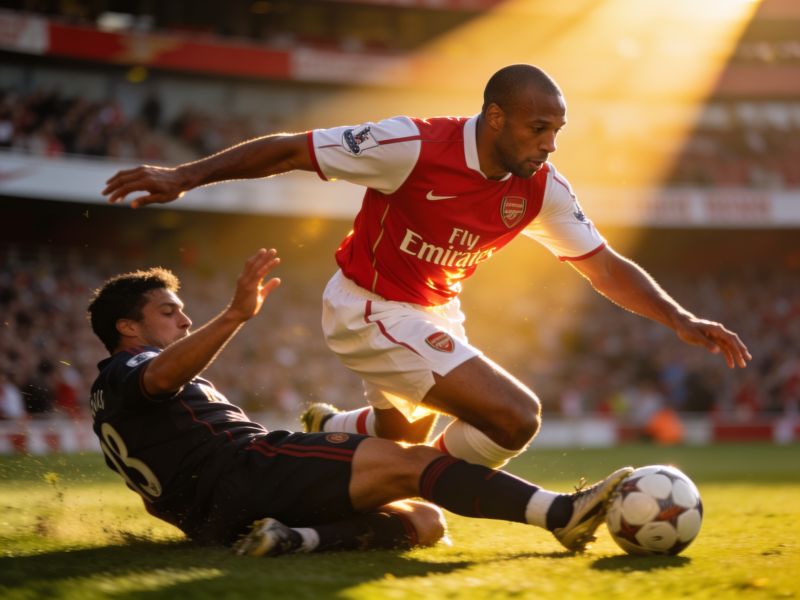
hierry Henry didn't just play for Arsenal. He became the visual shorthand for everything the club aspired to be between 1999 and 2007 — fluid, devastating, and impossibly cool. You can still see it in the archives: that loping stride, the way he'd drag a ball across a defender with the sole of his boot, the finish invariably rolled into the far corner rather than blasted. The stats are absurd — 228 goals in 377 appearances, four Golden Boots, two FA Cups。two league titles — but the numbers miss the point. Arsenal Henry was a stylistic revolution, not just a scoring machine.Consider the 2003-04 Invincibles season. Henry scored 30 league goals, but his real contribution was gravitational. Opponents didn't just defend against him;they warped their entire shape to compensate for his left-side drift. I remember a 5-0 win over Leeds at Highbury where he didn't score until the 60th minute, yet Leeds had already doubled up on the left flank for an hour, leaving Dennis Bergkamp free to pick passes. That's the underrated part of Arsenal Henry's legacy: he made space for others by simply existing near the touchline. Robert Pires and Ashley Cole feasted on the overloads Henry created without touching the ball.What separated him from other prolific strikers was the economy of his movement. Henry rarely sprinted aimlessly. Watch the 2002 North London derby at White Hart Lane — the one where he ran from his own half, glided past Stephen Carr, and slid the ball under Kasey Keller. He covered maybe forty yards in six touches. No wasted steps. No theatrical flourishes. The finish was almost apologetic. That goal。more than any hat-trick, defined Arsenal Henry: a player who treated defenders as obstacles to be bypassed rather than bodies to be battered.His departure in 2007 to Barcelona felt inevitable but left a strange aftertaste. Arsenal haven't won a league title since. Is that Henry's fault?
Of course not. But his exit marked the end of a specific identity — the club that could out-football anyone on a wet Tuesday in Stoke. The Emirates era brought prettier stadiums and uglier results. Henry returned on loan in 2012 and scored within minutes against Leeds, a neat little bookend. The celebration said everything: not a primal scream, just a quiet nod, as if he'd never left and the intervening years were a clerical error.Arsenal Henry isn't a nostalgia act. It's a benchmark. Every striker who arrives at the club now gets measured against a standard no one has met for nearly two decades. Bukayo Saka comes closest in spirit, but he's a winger, not a focal point. The truth is uncomfortable: Arsenal Henry represented a peak that the modern club hasn't approached. That's not a knock on the current squad. It's just what happens when you lose a player who made the extraordinary look routine for eight straight years. You spend the next twenty trying to remember how it felt.